by Andrey Filippov
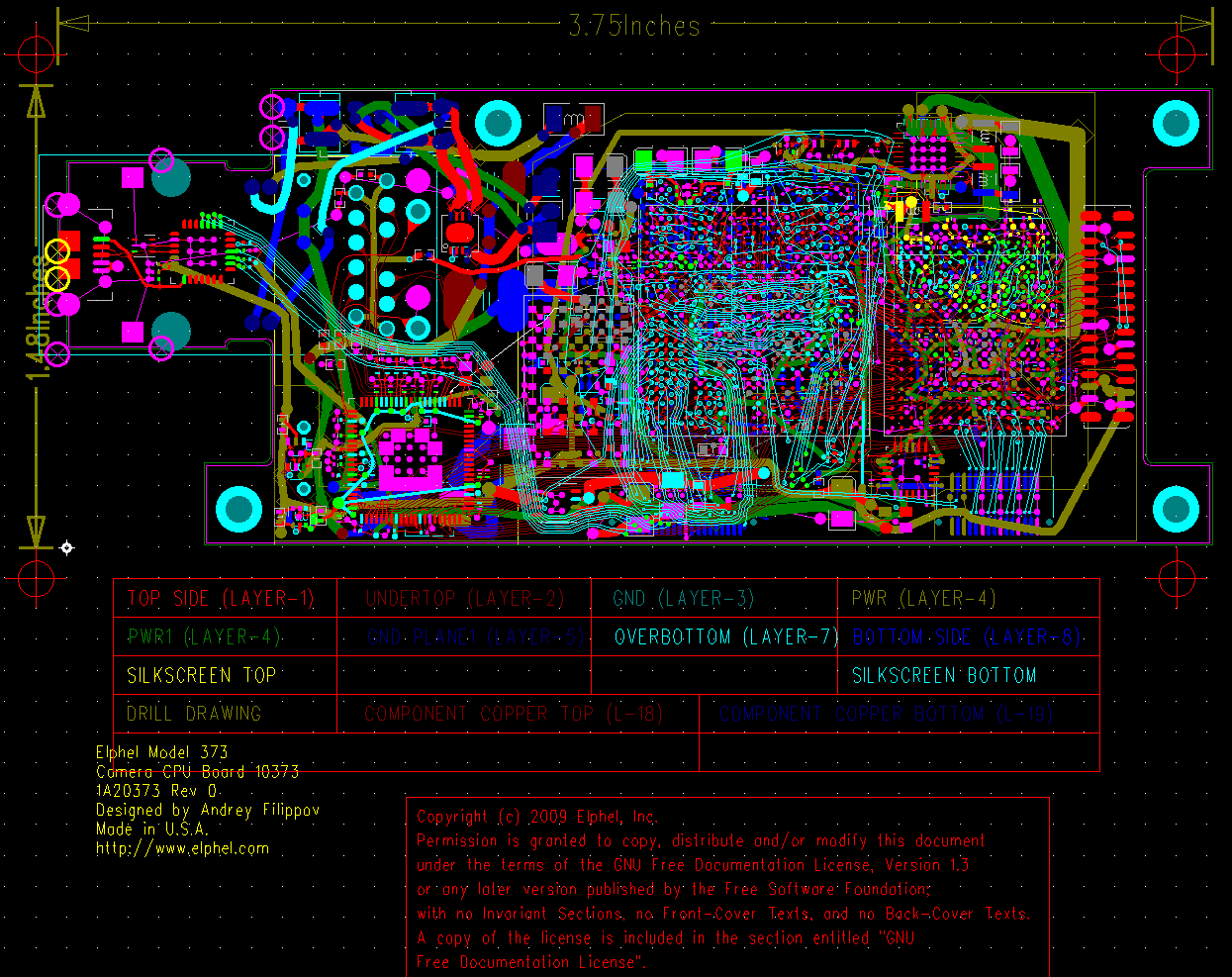
I do not know why search engines love this 8-year old page – current camera model is 393. It’s PCB layout is also available in both Gerber and PDF form on this wiki page.
I’m working now on the 10373 PCB layout – there will be some minor cleanup and double-checking all the new components used, their mechanical dimensions and pinouts, but so far I was able to fit all the components to the same size PCB and route all the traces. Sure I had to use more layers – there are 8 now, including 4 dedicated to ground and power planes, there are now blind laser microvias between the the outer layers and the next ones, some buried vias and reduced traces widths.
And there is even some room left on the board – something to be added later in the next revision.
Andrey
by Oleg Dzhimiev
1. [Done] Wrote code for the FFT256 DIF.
FFT is performed in 8 conveyor organized stages. Each stage is similar to as described here. So far each stage uses 2 BRAM ports (A for 16-bit Re-part and B for 16-bit Im-part) and the 1 MULT18X18 (for the “butterfly”) – 4 BRAMs + 6 MULT18X18s (MULTs are not used in the last 2 stages). Plus other logic – 1 FFT256 uses 18% of FPGA resourses.
Each BRAM is shared by 2 stages for write and by 2 stages for read (e.g., write – stages 2,3 and read – stages 3,4) – and because the address bus is used for 4 double accesses then each channel double writes/reads every 8 tacts – this results in:
Load time + Computation time + Readout time @10ns Clk ~ 2.5us + 8×10us + 2.5us = 85us =(
1a. [Done] Removed 2 MULTs from the stages 7 & 8 – because the sine and cosine are +/-1 or 0 – no need in multiplication.
2. [In Progress] FFT256 verification – calculated coefficients in OOo Spreadsheet – for tested sequence the results are almost equal – will be better to move it to the testbench.
TODO: (almost the same because initially there was a DIT algorithm and I was writing DIF)
- Write a correlation computation block.
- Make FFT run faster – get away from full buffering between stages.
- Set up memory controller for frames read/write.
- Integrate the correlation block to 10359’s firmware.